Support The Organization for Black Struggle

FOR IMMEDIATE RELEASE: Racial Justice Coalition Rejects St. Louis NAACP’s Call for Jail Expansion, Corrects Misleading Claims in Public Response

FOR IMMEDIATE RELEASE: Racial Justice Coalition Rejects St. Louis NAACP’s Call for Jail Expansion, Corrects Misleading Claims in Public Response

October 20, 2026

(ST. LOUIS, MO)–A coalition of local, Black-led organizations dedicated to decarceration and re-envisioning public safety has issued an open response to the St. Louis City NAACP regarding its recent report about the City Justice Center (CJC). While acknowledging shared concerns over inhumane conditions, medical care, and accountability at the CJC, the coalition  strongly opposes any recommendation to expand St. Louis’s jail capacity or build a new facility. The response not only cautions against this approach, but corrects the misleading premises used to support the NAACP’s argument.  

Written as a direct, open letter to the local NAACP, the coalition appeals to shared values, stating: “given our shared concern for Black people and communities in this region that have been marginalized and disempowered for generations, we believe it is essential to recognize that any call to expand the carceral footprint is a call to criminalize and cage more Black bodies.”

The response is grounded in a historical understanding that St. Louis’s criminal legal system and detention facilities have long been sites of death and devastation, impacting primarily Black residents from resource-starved communities. As such, to expand or build a new jail is not only unwise, but irresponsible, and especially when the call for expansion relies on misrepresentations of and omissions from local history, bail reform, and community advocacy. These include:

    1. Mischaracterizing the Workhouse: The report incorrectly frames the Workhouse as a minor “436-bed overflow facility” when, in actuality, the city expanded the Workhouse to 1,222 beds in 2002, which inherently guaranteed more people were detained pretrial. Closing it significantly cut incarceration levels, an impact that must be protected. Additionally, the letter reiterates a critical correction: severe issues at CJC predate the Workhouse closure, reflecting the fact that jails are fundamentally inhumane and the problems in the CJC cannot simply be attributed to the Workhouse. 
    2. Distorting Bail Reform: The report mischaracterizes local bail reform efforts by suggesting that they have been narrowly focused on the elimination of cash bail and ignored other elements of the pretrial detention system. In fact, community efforts to eliminate cash bail have always been paired with calls for more investment in community resources and diversion away from the criminal legal system. While eliminating cash bail has contributed to a lower jail population overall, judges shifting from “cash bail” to “no bail allowed” ensured that far too many presumptively innocent people have not been able to fight their cases from home, leaving them jailed at CJC for months and years. 
    3. Ignoring Impacted Voices: the NAACP relied entirely on city officials, police, and contractors, the very parties responsible for creating these conditions; and ignored people detained and their families, court watchers, and advocates who have raised concerns, called for change, transparency, and accountability, and litigated these issues.

The coalition urges the St. Louis City NAACP to retract its recommendation for jail expansion and align around community-based solutions instead of cages. 

The full open letter is available here. 

For nearly a decade, the organizations signed onto the letter– Action St. Louis, ArchCity Defenders, Care Not Cages campaign, [Coalition Against Police Crimes and Repression], Freedom Community Center, Missouri Justice Coalition, No More Jail Deaths campaign, [Organization for Black Struggle], and Some Things Must Be Heard– have led efforts supporting alternatives to incarceration and investment into community wellbeing in St. Louis. 

Some of the key initiatives anchored by coalition members include: the Close the Workhouse campaign, the Prosecutor Organizing Table, the Defund. Re-envision. Transform campaign, and The People’s Plan St. Louis. 

Media Contact:

Z Gorley, Director of Communications, ArchCity Defenders 
(314) 898-8185 | zgorley@archcitydefenders.org

.org 

Recent Posts

Paris Crayton III’s Brothers of Affliction – Nov 5-8, 2026

Brothers of Affliction is a powerful and intimate drama about three estranged brothers brought together for one volatile night inside the home that still holds the scars of their childhood. Tyriq wants answers about the father who abandoned them, while Chris and Shane have spent years surviving by refusing to confront the past. As alcohol, anger, and old resentments loosen their defenses, buried memories surface, forcing the brothers to reckon with abuse, violence, abandonment, and the very different ways each learned to survive.

Read More »

Sign up for Updates

Open Response to St. Louis City’s NAACP’s Call for Jail Expansion

Open Response to St. Louis City’s NAACP’s Call for Jail Expansion

VIA Arch City Defenders

Dear St. Louis City NAACP,

As Black-led organizations that have been deeply engaged with systems of criminalization and incarceration over the past decade, we observed closely the recent reporting regarding your call for expansion of the City Justice Center (CJC), or construction of a new jail. We have reviewed your report supporting this recommendation. We have major concerns and objections, as well as a number of corrections that we wish to offer. We hope you will take these seriously and consider redirecting your efforts, as it seems your recommendation has already caught the attention of local public leaders, who typically require little encouragement to invest ever more resources in carceral institutions. Given the public nature of this discourse, we are sharing this letter publicly as well as with you directly.

We start with a fundamental understanding that undergirds much of our work as racial justice organizations: the criminal legal system in St. Louis and the detention facilities that act as the receptacle for those trapped within that system are and have long been sites of death and destruction for Black St. Louisans. This is not only true for Black St. Louisans; indeed, these systems—which operate at a scale otherwise unknown throughout most of the developed world—are costly and harmful to all people. But given our shared concern for Black people and communities in this region that have been marginalized and disempowered for generations, we believe it is essential to recognize that any call to expand the carceral footprint is a call to criminalize and cage more Black bodies. As a matter of principle, we find this unconscionable and unacceptable.

However, we do understand, and deeply relate to, your concern with the conditions which plague those held in the city’s cages. We know that you are aware of this longstanding concern given your report’s repeated citations to the work of our organizations over the past decade. There are many such references—at least 15 by our count—including published reports, media coverage, and federal litigation. We are heartened that you have engaged extensively with our work. We are disappointed that you have misrepresented that work in some key respects.

We can certainly appreciate that there are many editorial choices to be made in attempting to summarize the history on a topic as widely discussed and debated as jail policy and practices in St. Louis. And we do not take on the task of responding to the entirety of a 43-page report on the subject, particularly since we are in strong agreement with many of your recommendations related to transparency, improved medical care, civilian oversight, continued bail reform, expanded pretrial services, and accountability for inhumane and abusive treatment. (We have loudly advocated for these changes and more for the CJC, specifically, for years.) However, we feel compelled to address three major issues in the report in hopes that you will reconsider your approach in future communications.

First, we would like to correct and expand on the history of the Workhouse, its function as a city jail facility, and the impact of its closure on jailing in St. Louis. We appreciate the obvious effort to provide so much historical context, as it is crucial in discussing this issue. We are, however, struck by the omission of Judge Clyde Cahill’s extensive comments regarding the impact on poor Black communities in his 1990 opinion—an opinion that is cited in your report for various other findings. We have long believed that Judge Cahill’s opinion holds the key to understanding the core function of the Workhouse in St. Louis history, so we include extended excerpts from that opinion here:

Certain neighborhoods in St. Louis have become the target of intensive police activity… These intrusive tactics, coupled with detention because of poverty, lead to a destruction of confidence in the criminal justice system. . . .

Prisons and punishment alone cannot be the answer—there must be encouragement, assistance and above all, confidence in the fairness of the legal system. Mass detention for petty offenses now may give temporary relief but it only postpones the misery to come.

Most of the persons now arrested for these drug-related offenses are young black men from North St. Louis. Their prospects are as bleak as their surroundings. . . While the racial connotations of this issue are seldom mentioned, they may, nonetheless, be a factor in the public’s perception of the drug problem. There are myths, which have been partially developed by the media, that only minorities are involved with drugs. The City’s prison population, nearly all black, perpetuates this misconception. The Court does not believe that racial identity is used as a factor in these matters; but nonetheless, because most blacks who are arrested are poor, they are more likely to be detained when denied recognizance.[1]


In other words, the Workhouse was not just a decrepit and inhumane facility—though it was that. It was a warehouse for caging poor Black St. Louisans starved of resources in their communities. We know well that many people would love to strip that essential context from a historical understanding of the Workhouse, but we assume that is not the intention of the St. Louis City NAACP.

This history also helps to explain why the Workhouse, in the years leading up to its closure, was not merely a “436-bed . . . overflow and sentenced-detainee facility” in a city with “capacity for roughly 1,300 detainees across two separate physical plants,” as your report states. These numbers are incorrect, and significantly so. In fact, in 2002, the City expanded the capacity of the Workhouse to 1,222 beds. The city’s own Inmate Population Dashboard[2] shows that the city jail population exceeded 1,300 every year between 2003 and 2017. It peaked at 2,372 in 2007. And in every single one of those years, the Workhouse population exceeded that of the CJC, which was often reserved for individuals the City deemed to have “more serious” charges (contrary to your assertion that the CJC was intended for “low-risk, unable-to-pay detainees”).

Accordingly, the Workhouse was not some minor overflow facility; it was the central driver and receptacle for pretrial incarceration in St. Louis. This is important in two respects: first, in forming an accurate understanding of the movements to close the Workhouse and end cash bail, as explained further below; and second, in properly characterizing jail population trends. At multiple points in your report, you suggest that the current jail population is comparable to the population pre- Workhouse closure. (“Population did drop for a period. It has now rebounded.”; “The population effect of these countervailing trends has been meaningful but not permanent.”)

This is a profound misunderstanding. Yes, the population decline has reversed over the past four years. We are deeply concerned about that. But, even with this recent increase, today’s levels are a fraction of what they were throughout the years that both the Workhouse and CJC were in full operation. This is the impact of closing the Workhouse, an impact that should be prized and protected by all who understand the social and racial dimensions of mass incarceration. This is why it is unwise and irresponsible to pursue jail expansion or new jail construction.

As an important final point on the impact of closing the Workhouse: the problems with the CJC did not begin when the Workhouse closed. In our work, we have called this a “zombie lie” because it continues to proliferate no matter how many times it is disproven. Yet this fallacy is embedded throughout your report, including in the Executive Summary, which claims the “current death and overdose toll . . . is the predictable outcome of decisions the city made a generation ago—closing the Workhouse without expanding downtown capacity . . .” This is especially confusing because the report gives extensive treatment to the task force established to address the crisis conditions leading to a mass uprising inside the CJC and revealing broad structural and cultural deficiencies—all of which occurred in February and March of 2021.

The problems in the CJC started before the closure of the Workhouse, not after. That is not a matter of interpretation; it is a knowable, confirmable fact—one that we have noted on previous occasions[3]. We are disappointed that bad-faith actors continue to perpetuate falsehoods about the relationship between these two jail facilities, and we are concerned that even sincere, well-meaning advocates like the City NAACP have apparently come to believe these falsehoods.

Our second major area of concern is that your report misrepresents the local movements to close the Workhouse and end cash bail. We assume these are honest misunderstandings, but they are still important. The report spends several paragraphs discussing what it titles “The bail-reform interaction.” Quoting from that section: “The NAACP’s read of this record is that the no-cash-bail movement did what its supporters intended it to do—it stopped detaining presumptively innocent people because they were poor—but that the movement was not paired with a matching investment in pretrial services, community-based supervision, medically supervised diversion, and mental-health and substance-use alternatives.” [emphasis in original]

This is another confusing statement and one of a few places in the report where you seem to conflate the “movement,” or community advocates and organizers, with the policymakers responsible for having taken or not taken any number of official actions over the past decade. But given this explicit reference to cash bail abolition supporters, and attribution of intent to them, it is surprising that your report so deeply miscalculates this intent. While this section of the report does not name any specific people or organizations, we feel quite confident that the undersigned organizations merit prominent inclusion in any list of local supporters of the “no-cash-bail movement.” As such, we presume to speak from that perspective.

It is simply inaccurate to suggest that we were fully satisfied by the 2019 bail reforms in St. Louis. Despite meaningful gains, our dissatisfaction should be obvious given that our organizations continued litigating bail claims, operating court-watching programs, releasing reports highlighting ongoing pretrial abuses, and offering commentary calling for more significant changes. Critically, we have emphasized repeatedly the need for a paradigm shift away from detention and supervision and toward services and support.

Here, we find it helpful to reference the much-discussed published materials of the Close the Workhouse (CTW) campaign. (In case it is not clear, there has been a very close relationship between these efforts. Also, like the cash bail elimination effort, CTW is implicated in your report’s discussion of “the decision not to plan” for the jail’s closure.) CTW’s seminal 2018 report[4], “The Plan to Close the Workhouse,” presents four different steps to accomplish the campaign’s goals: (1) release individuals incarcerated pretrial, (2) close the Workhouse, (3) decline to prosecute and criminalize individuals (emphasizing crimes of poverty and substance addiction), and (4) reinvest in communities. There were specific, individualized action steps outlined for the Mayor, Circuit Attorney, and Board of Aldermen. And for the reinvestment of funds, there were proposals to “Fund This Instead,” including: affordable housing, community-based mental healthcare, neighborhood-based community spaces that are open to all, economic and funded educational opportunities, and retraining programs for former jail employees. Finally, there was a section underscoring the importance of robust pre-plea diversion and “pretrial services, not surveillance.”

To the extent that the City NAACP intends to communicate its agreement and alignment with this 2018 vision in its new report, we welcome and commend it. We strongly disagree, however, with your assertion that “the City under-invests in detention capacity.” We hope that you will revisit our organizations’ consistent offerings on these issues through the years, take that into account in describing these efforts in the future, and reconsider your own conclusions regarding the ideal level of carceral funding in St. Louis.

The third and final issue we want to raise concerns the City NAACP’s decision to rely entirely on meetings and communication with city agencies, contractors, and the federal government in forming an understanding of and response to the problems with the CJC. Based on your report, the findings and recommendations were based on conversations with the City’s Director of Public Safety, Interim Sheriff and members of his staff, Division of Corrections personnel, the contracted medical provider, Chief Robert Tracy and other SLMPD command staff, and the Archview facility as prospective medical provider, written correspondence with the Special Litigation Section of the U.S. Department of Justice Civil Rights Division[5], and review of various published materials.

Given your apparent interest in ongoing involvement with the administration of jail operations—an interest we do not share—we can appreciate the value of those conversations for you. Still, we believe you have missed important perspectives. It is clear to us that the decision not to communicate directly with advocacy and community organizations that have been deeply engaged with these issues for many years led to major gaps in your reporting and analysis. For several years and to this day, our organizations and others have sustained federal litigation involving conditions and practices in the CJC, direct actions and campaigns to decarcerate and end the jail deaths, advocacy supporting real civilian oversight, and data collection and reporting on in-custody deaths in the St. Louis region. That knowledge and expertise might have been helpful to you as well.

Far more importantly, though, there are, sadly, many people and families that have direct experience with the CJC from all angles. There are people who have suffered greatly. There are people who have extensive experience with the operating practices of the jail from the perspective of a detained person. There are people who have lost loved ones in the CJC’s cages.[6] In our view, these are invaluable perspectives, and it is a mistake to offer solutions and recommendations without soliciting and incorporating these voices.[7] It is not lost on us that the agencies and officials you took the time to consult are those who have created the conditions that we would all like to change.

As a closing note, we reiterate that we share your assessment that there is an urgent need for change on many fronts related to the City Justice Center. This is a life-and-death matter and, as such, one that we approach with the utmost seriousness. We have seen firsthand the cost of getting it wrong. It is time for us to get it right, and that includes many of the things that you have called for in terms of oversight, transparency, investment in medical care and services supporting release and return to community. Your recommendation to expand the city’s jail capacity to incarcerate more people both undermines these imperatives and raises the potential for more suffering, now and in the future. We urge you to reconsider and retract this recommendation, as we remain steadfastly opposed to any effort to pursue that goal. We look forward to working together on those issues where there is genuine alignment. Our community expects and deserves a principled and unified approach to this critical issue from all those involved.

Very sincerely,

Action St. Louis

ArchCity Defenders

Care Not Cages campaign

Coalition Against Police Crimes and Repression

Freedom Community Center

Missouri Justice Coalition

No More Jail Deaths campaign

Organization for Black Struggle

Some Things Must Be Heard


[1] Tyler v. United States, 737 F. Supp. 531 (E.D. Mo. 1990)

[2] https://www.stlouis-mo.gov/data/dashboards/inmates/index.cfm

[3] https://www.archcitydefenders.org/acdjj14/

[4] “The Plan to Close the Workhouse & Promote a New Vision for St. Louis,” 2018, available at https://archcitydefenders.org/wp-content/uploads/2019/03/CloseTheWorkhousePlan_Rev110112018-1.pdf

[5] We are highly skeptical that this Department of Justice will serve as a productive oversight body to ensure humane jail conditions and practices. Still, we feel compelled to note that correspondence with DOJ officials does not constitute federal oversight.

[6] Many of the people and families that have been impacted by this system in recent years have come together under the banner of “No More Jail Deaths,” a campaign demanding humane treatment and conditions for people detained in the city’s cages.

[7] We are also concerned that your report offers new public details regarding a recent in-custody death without having communicated these same details to the family of the deceased individual.

Recent Posts

Paris Crayton III’s Brothers of Affliction – Nov 5-8, 2026

Brothers of Affliction is a powerful and intimate drama about three estranged brothers brought together for one volatile night inside the home that still holds the scars of their childhood. Tyriq wants answers about the father who abandoned them, while Chris and Shane have spent years surviving by refusing to confront the past. As alcohol, anger, and old resentments loosen their defenses, buried memories surface, forcing the brothers to reckon with abuse, violence, abandonment, and the very different ways each learned to survive.

Read More »

Sign up for Updates

Graduate Internship for the Organization for Black Struggle Archive Project

Graduate Internship for the Organization for Black Struggle Archive Project

The Organization for Black Struggle (OBS) is seeking a summer intern to work with the team on a collaborative project with several partners. They include, but are not limited to, the UMSL Museum Department, the State Historical Society of Missouri (SHSMO), and We Are St. Louis. The team will include interns working with our partners.

We are seeking a graduate student, ideally in a history or museum studies M.A. program, with a strong interest and/or experience in digital platforms, social movement history, Black history, St. Louis history, participatory digital public history, user-generated archival content, metadata, content management systems, including omeka and the oral history metadata synchronizer (OHMS), and/or digital user experience (UX). OBS is seeking self-motivated applicants with strong time management, communication, and interpersonal skills.

The internship runs from June 1 to August 7, 2026, requiring a minimum of 20 hours per week for 10 weeks, with a pay rate of $20 per hour. The intern will report directly to Jamala Rogers, Executive Director.

Applications are due by 4/30. Please submit a resume and cover letter reflecting relevant experience, training, and scholarly interest in the content. Applications should be emailed to lara.kelland@umsl.edu.

OBS is an equal opportunity employer and strongly encourages applications from people of color, individuals with disabilities, women, and LGBTQIA+ applicants.

Recent Posts

Paris Crayton III’s Brothers of Affliction – Nov 5-8, 2026

Brothers of Affliction is a powerful and intimate drama about three estranged brothers brought together for one volatile night inside the home that still holds the scars of their childhood. Tyriq wants answers about the father who abandoned them, while Chris and Shane have spent years surviving by refusing to confront the past. As alcohol, anger, and old resentments loosen their defenses, buried memories surface, forcing the brothers to reckon with abuse, violence, abandonment, and the very different ways each learned to survive.

Read More »

Sign up for Updates

OBS Statement on March 2026 Youth Detainment

OBS Statement on March 2026 Youth Detainment

We are outraged over the treatment of youth last weekend by the Mayor of St. Louis and SLMPD. After incidents were reported in North City, South City, and Downtown on 314 Day Weekend, the Mayor put a 10pm curfew in place for Downtown the following weekend. Many of us did not even know about this curfew as we don’t follow SLMPD on social media. As a result, 23 youth from ages 11 to 17 were threatened, harassed, zip-tied, thrown into SLMPD vehicles, and taken to a non-disclosed location. Now, their families have to appear in court and face fines of up to $500 or 90 days in jail. SLMPD reports that no weapons were recovered from any of the 23 youth detained.

We have strong disagreement with the Mayor’s decisions and the misleading and harmful statements that followed. The Mayor claims the curfew was put in place Downtown because that’s “where the majority of violence occurred the weekend prior.” However, only 3 incidents were reported Downtown on 314 Day
Weekend, with the others occurring in North City and South City. In her statement calling this mistreatment and detention of 11-17 year olds “a success,” she referred to the 23 youth as “juveniles” four times, which is a targeted legal term that dehumanizes young people. It’s clear to us that the Mayor does not view the youth of St. Louis in a positive light, but is rather prioritizing her desired image of Downtown, no matter who is harmed.

It’s clear to us that there was a failure to understand the facts of the incidents that took place on 314 Day Weekend, from who was responsible to where they actually happened. The Mayor activated SLMPD to target and detain any youth who were Downtown after the poorly communicated curfew, and then penalize their families. This in no way addressed the incidents that took place the previous weekend or creates safety for youth.

We do not condone the reported incidents that took place on 314 Day Weekend. We want a safe city, too. But detaining 23 11-17 year olds causes trauma and does not create safety. Fining or locking up their parents does not create safety. Those reactionary practices are punitive, harmful, and dehumanizing to our youth who were not even responsible for the incidents that took place on 314 Day Weekend.

Safe spaces for youth exist, and have existed for decades. What does not exist is support and investment from city government. Instead of investing in safe spaces for youth, city government has decided to misappropriate funds into harassing and detaining youth. The Mayor’s decisions harmed 23 youth and their families.

The City’s choices and actions this month are strong indicators of the need for change on the City’s part, from communications to funding. We are asking the following of the Mayor:

  1. 1) Immediately remove the court dates, charges, and fines for the families of the 23 11-17 year olds who were detained on March 20, 2026. The detaining of these young people was already too punitive a measure.
  2. Release a statement apologizing for the mistreatment and mischaracterization of the 23 11-17 year olds detained, including referring to them as “juveniles.”
  3. Make funding for youth organizations abundant and accessible. Prioritize the budget to center youth and families. Remove the many obstacles in the way of youth organizations receiving funding. Reach out to youth organizations directly for input on funding and other resources.

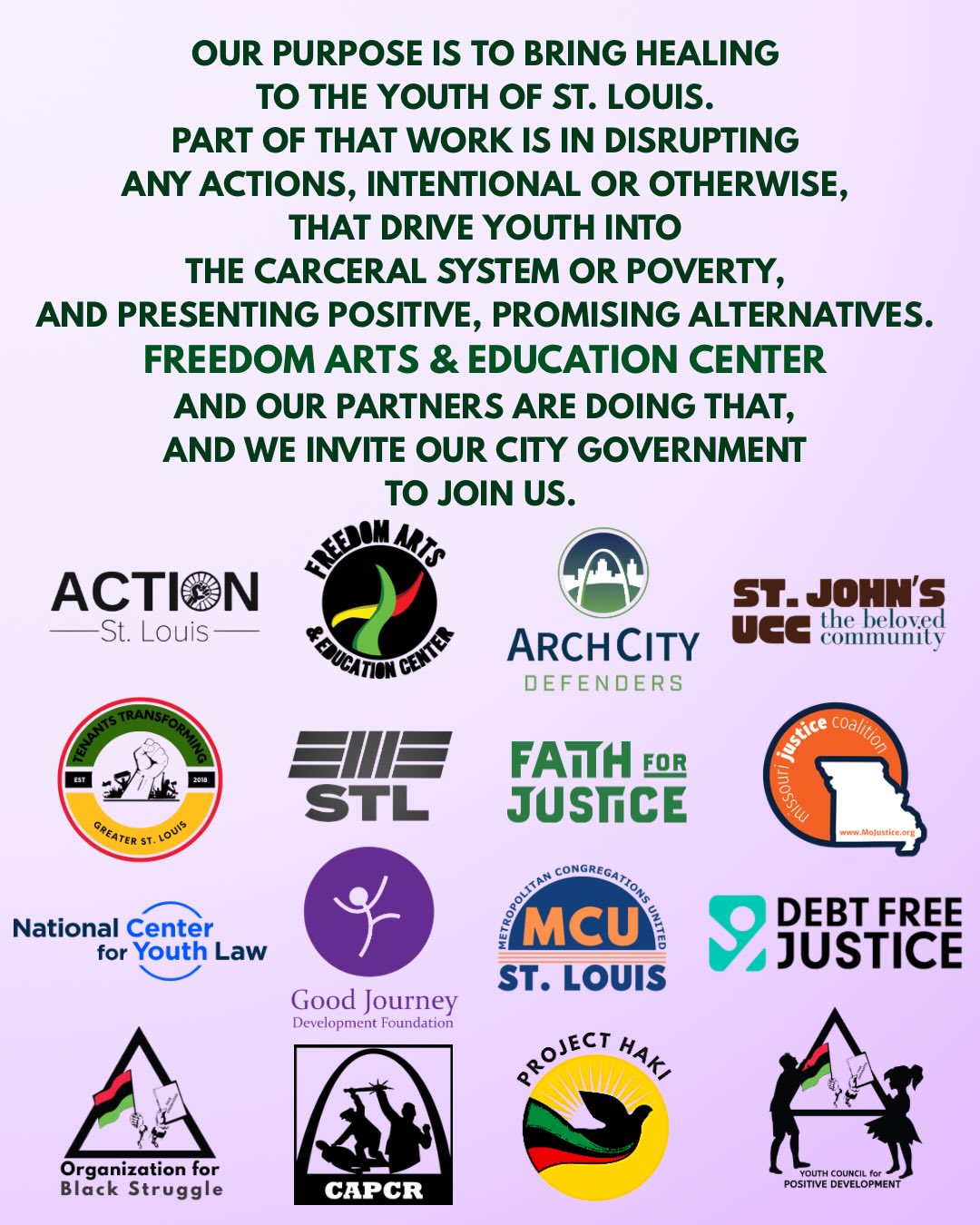
Our purpose is to bring healing to the youth of St. Louis. Part of that work is in disrupting any actions, intentional or otherwise, that drive youth into the carceral system or poverty, and presenting positive,promising alternatives. Freedom Arts & Education Center and our partners are doing that, and we invite our city government to join us.

Freedom Arts & Education Center
Faith For Justice
St. John’s Church – The Beloved Community
Action St. Louis
ArchCity Defenders
Tenants Transforming Greater St. Louis
Debt Free Justice
National Center for Youth Law
Missouri Justice Coalition
Good Journey
Black Men Build
Organization for Black Struggle
Coalition Against Police Crimes and Repression
Youth Council for Positive Development
Project Haki
Metropolitan Congregations United for St. Louis

Recent Posts

Paris Crayton III’s Brothers of Affliction – Nov 5-8, 2026

Brothers of Affliction is a powerful and intimate drama about three estranged brothers brought together for one volatile night inside the home that still holds the scars of their childhood. Tyriq wants answers about the father who abandoned them, while Chris and Shane have spent years surviving by refusing to confront the past. As alcohol, anger, and old resentments loosen their defenses, buried memories surface, forcing the brothers to reckon with abuse, violence, abandonment, and the very different ways each learned to survive.

Read More »

Sign up for Updates

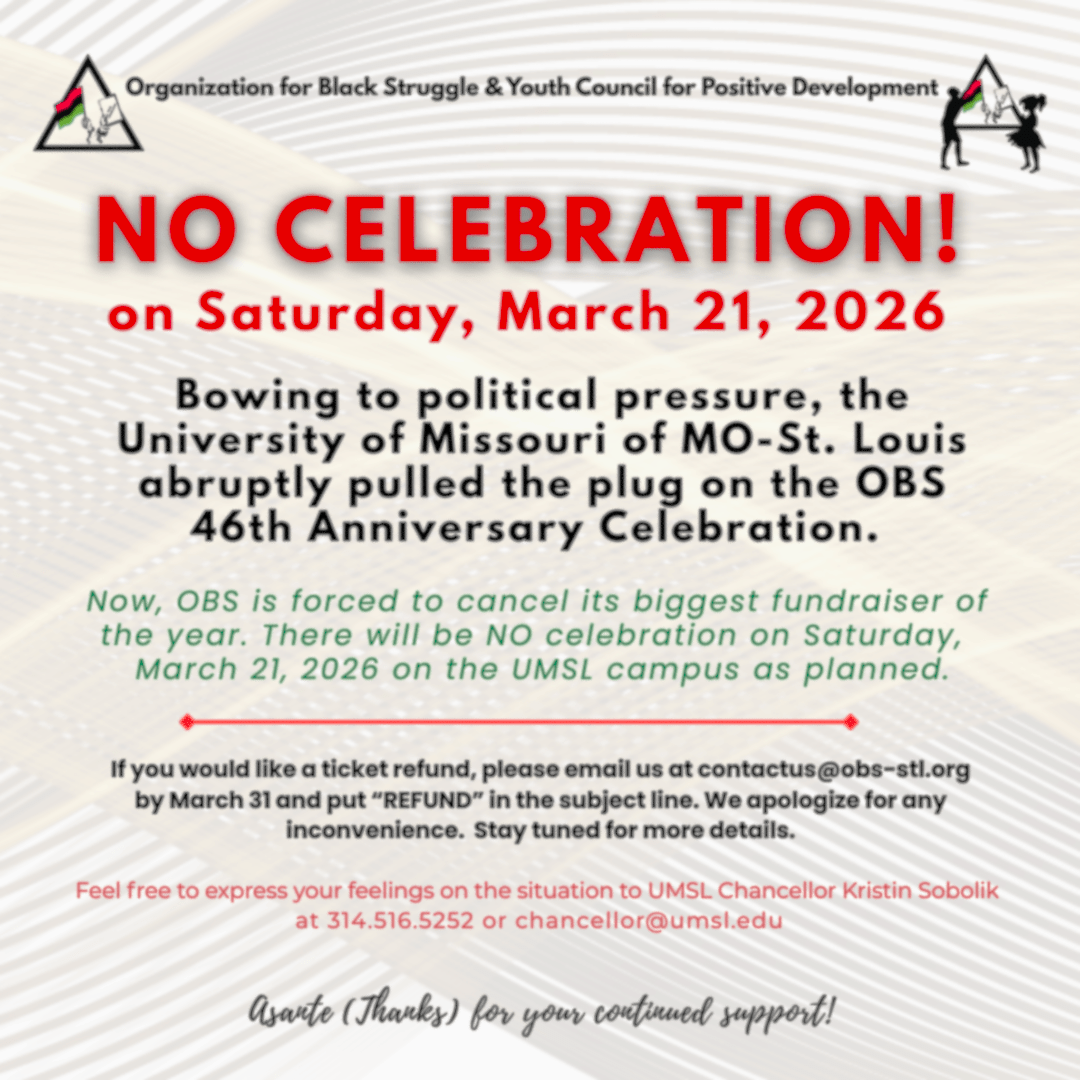
UMSL CANCELS THE 46TH ANNIVERSARY PROGRAM OF THE ORGANIZATION FOR BLACK STRUGGLE

UMSL CANCELS THE 46TH ANNIVERSARY PROGRAM OF THE ORGANIZATION FOR BLACK STRUGGLE

For Immediate Release
March 16, 2026

Months in the planning, the University pulled the plug one week before the big event St. Louis – The 46th anniversary celebration of the Organization for Black Struggle was rescheduled due to the January snowstorm. This year’s event marked a significant departure from previous celebrations: the dinner portion was eliminated, and for the first time, the event included a partnership with the Museum Department of the University of Missouri-St. Louis (UMSL).
Since 2024, 

OBS and UMSL have been actively collaborating on OBS’s legacy project, with the Missouri State Historical Society housing OBS’s digital archives. The archive project was scheduled to be publicly launched at the anniversary celebration. From its inception in 1980, OBS has forged strong connections with UMSL, engaging with various student groups, departments, and initiatives over the years.

This shared history made the news of the event’s cancellation just one week prior even more troubling. The inconsistent explanations suggest that external pressure may have influenced the university’s decision. If there was an administrative issue with the contract, it was internal to the departments involved, yet OBS will endure most of the consequences.

The cancellation affected its largest fundraiser of the year and is likely to create financial hardship for the organization in the future. OBS firmly believes that UMSL bowed to political influences, likely due to the organization’s
long and unwavering stance on police accountability and its outspoken opposition to the state takeover of the St. Louis Police Department.

“With the long relationship OBS has had with UMSL, we have to acknowledge that what makes it different now is the political climate in Missouri,” said Jamala Rogers, OBS spokesperson. “Add to that my role as plaintiff in Rogers v State of Missouri, and that UMSL is the secondary employment for St. Louis Police Chief Robert Tracy. We don’t believe any of this is a coincidence.”

OBS remains unapologetic in its commitment to police accountability and community control. MAGA policies threaten democracy, and this requires greater citizen participation than ever.

Recent Posts

Paris Crayton III’s Brothers of Affliction – Nov 5-8, 2026

Brothers of Affliction is a powerful and intimate drama about three estranged brothers brought together for one volatile night inside the home that still holds the scars of their childhood. Tyriq wants answers about the father who abandoned them, while Chris and Shane have spent years surviving by refusing to confront the past. As alcohol, anger, and old resentments loosen their defenses, buried memories surface, forcing the brothers to reckon with abuse, violence, abandonment, and the very different ways each learned to survive.

Read More »

Sign up for Updates

Black Leaders Detroit Highlights the 2025 Ride For Equity: Road to Reparations in St. Louis, Honoring the Legacy of Black Wall Street

Black Leaders Detroit Highlights the 2025 Ride For Equity: Road to Reparations in St. Louis, Honoring the Legacy of Black Wall Street

St. Louis, MO — Black Leaders Detroit (BLD) is proud to announce the launch of the 2025 Ride For Equity: Road to Reparations, an extraordinary cross-country bike ride dedicated to raising awareness and support for Black entrepreneurs. Beginning on May 31, 2025, this transformative five-week journey will commence in Tulsa, OK, and conclude near Independence Day at Wall Street in New York City.

In partnership with the Urban League of Metropolitan St. Louis, Inc., Upsilon Omega Chapter of Omega Psi Phi Fraternity, Organization for Black Struggle, and the NAACP of St. Louis County, BLD is honored to start this journey in St. Louis, a city committed to fostering equity and opportunity for all. This ambitious 35-day ride brings together cyclists, community leaders, and supporters from across the nation to move for the movement and advocate for closing the racial capital gap

“We are excited to embark on this monumental journey with our various St. Louis partners.” said Dwan Dandridge, CEO of Black Leaders Detroit. “Together, we can honor the past, inspire the present, and create a future rooted in fairness and equitable access to opportunity.”

A Legacy of Advocacy and Impact Since 2020, BLD has organized an annual 377-mile bike ride from Detroit to the Mackinac Policy Conference, spotlighting the barriers entrepreneurs of African descent face in accessing capital. Last year,
over 250 participants joined the six-mile kickoff event, with 15 dedicated riders completing one or more full days of the journey. Building on this legacy, the 2025 Ride For Equity elevates the mission to a national scale, fostering action and
dialogue from Black Wall Street to Wall Street. 

Community Events and “Speak For Yourself” Forums The journey will feature community conversations titled “Speak For Yourself” in key cities along the route. These forums have proven instrumental in fostering understanding and building bridges across diverse communities. St. Louis forum will be hosted by the Urban League of Metropolitan St. Louis, Inc and the Upsilon Omega Chapter of Omega Psi Phi Fraternity, on Sunday, June 8th at 5pm. The discussion will take place at the Omega Center, 3900 Goodfellow Blvd, St. Louis, MO, 63120.

Join Us in St. Louis We invite local media, influencers, and community members to cover and participate in this historic ride.

Call to Action Black Leaders Detroit invites everyone to join this transformative journey by riding, volunteering, donating, or sharing the mission. More details about the 2025 Ride For Equity can be found at ride4equity.org. Together, let’s honor the legacy of Black Wall Street and ride for equity, justice, and economic empowerment.

Recent Posts

Paris Crayton III’s Brothers of Affliction – Nov 5-8, 2026

Brothers of Affliction is a powerful and intimate drama about three estranged brothers brought together for one volatile night inside the home that still holds the scars of their childhood. Tyriq wants answers about the father who abandoned them, while Chris and Shane have spent years surviving by refusing to confront the past. As alcohol, anger, and old resentments loosen their defenses, buried memories surface, forcing the brothers to reckon with abuse, violence, abandonment, and the very different ways each learned to survive.

Read More »

Sign up for Updates

MO JwJ Issues Joint Statement After Legislature Passes Bill to Strip Local Control of SLMPD

MO JwJ Issues Joint Statement After Legislature Passes Bill to Strip Local Control of SLMPD

Jefferson City, MO — The Missouri House of Representatives today passed House Bill 495 to remove the St. Louis Police Department from the control of the City of St. Louis and place it under the authority of a state-controlled Board of Police Commissioners, effectively eliminating local community oversight.

Missouri Jobs with Justice alongside Action St. Louis Power Project and the Organization for Black Struggle (OBS) had this to say in response:

“We are extremely disappointed that the Missouri Legislature has voted to send legislation to strip local control of the St. Louis Police Department to Governor Mike Kehoe’s desk — and with an emergency clause enabling the bill to immediately become law without public input and outrage. If this bill becomes law, it will inevitably exacerbate inequality in St. Louis—disproportionately increasing police power without local oversight in marginalized communities and implementing harsher penalties for minor offenses. Local control of police is a tool of civil rights reform deeply rooted in the community’s desire for accountability and a more sensitive approach to policing over their own community.

Putting the SLPMD under state control jeopardizes community safety, public accountability, and democratic processes. It’s a gross misuse of power to undermine the 2012 statewide referendum in which Missourians voted to overturn this Civil War-era arrangement of state control. Here we have an attempt by state officials to bypass standard political processes to force the state into submission, and yet another example of government overreach that hugely affects our lives and communities without our consent. The state should allow local elected officials accountable to
the community that they serve to continue working diligently to address concerns, instead of militarizing a state-appointed board.”

Recent Posts

Paris Crayton III’s Brothers of Affliction – Nov 5-8, 2026

Brothers of Affliction is a powerful and intimate drama about three estranged brothers brought together for one volatile night inside the home that still holds the scars of their childhood. Tyriq wants answers about the father who abandoned them, while Chris and Shane have spent years surviving by refusing to confront the past. As alcohol, anger, and old resentments loosen their defenses, buried memories surface, forcing the brothers to reckon with abuse, violence, abandonment, and the very different ways each learned to survive.

Read More »

Sign up for Updates

The Organization for Black Struggle Endorses Cori Bush for U.S. Congress

The Organization for Black Struggle Endorses Cori Bush for U.S. Congress

St. Louis. The Organization for Black Struggle (OBS) proudly endorses Congresswoman Cori Bush in her re-election to represent the 1st congressional district.

Time and time again, the Congresswoman has shown her compassion and commitment to the people of District CD-1. For carrying out her campaign promises, she has been targeted for attacks and slander by conservative forces who do not represent us.

Says OBS Executive Director Jamala Rogers, “We were disappointed that Wesley Bell has chosen to run against Cori Bush. We know that anyone has a right to run for public office, but it should be based on the incumbent not living up to their responsibilities to the constituents they vowed to serve. Cori has been an unwavering fighter and tireless servant for us, and we want to send her back to The People’s House.”

In addition to bringing billions of dollars home to the district to meet the challenging needs of St. Louis families, Cori has stood on principle in protecting reproductive and voting rights, in advocating for affordable and accessible housing and medical services, as well as standing up for the disenfranchised and marginalized citizens in this country.

Recent Posts

Paris Crayton III’s Brothers of Affliction – Nov 5-8, 2026

Brothers of Affliction is a powerful and intimate drama about three estranged brothers brought together for one volatile night inside the home that still holds the scars of their childhood. Tyriq wants answers about the father who abandoned them, while Chris and Shane have spent years surviving by refusing to confront the past. As alcohol, anger, and old resentments loosen their defenses, buried memories surface, forcing the brothers to reckon with abuse, violence, abandonment, and the very different ways each learned to survive.

Read More »

Sign up for Updates

Organization for Black Struggle
P.O. Box 5277
St. Louis, MO 63115
(314) 367-5959 | contactus@obs-stl.org

The Organization for Black Struggle (OBS)Demands Justice for the St. Louis Justice Center Residents Subjected to Inhumane Conditions

The Organization for Black Struggle (OBS)Demands Justice for the St. Louis Justice Center Residents Subjected to Inhumane Conditions

For Immediate ReleaseFebruary 8, 2021

Contact Person: Velta Smith (314.367.5959)

The insurrection that occurred on Saturday, February 6 at the St. Louis Justice Center in response to COVID-19 has been boiling for almost a year. The prolonged neglect by city officials starting with Mayor Lyda Krewson and Public Safety Director Jimmie Edwards is unconscionable and unacceptable. OBS must always remind the public that the city jail and the workhouse are holding facilities until citizens are arraigned and charged. They are innocent until proven guilty.

Last summer, the Organization for Black Struggle began getting calls from inmates who were confined to the St. Louis City and County jails. There were growing concerns about the pandemic and whether these institutions were following CDC guidelines to ensure the safety of both residents and staff. OBS reached out to the directors of both facilities to provide testing through Affinia Healthcare who was committed to sending its mobile units out.On June 29, OBS held a press conference to announce its efforts to get inmates tested at these facilities. We reported that the County used its own Department of Health to perform the COVID-19 tests but that city jail officials were unresponsive.

The new year began with OBS again receiving calls and emails from family members whose loved ones were confined to the Justice Center. We were informed that a guard had been taken hostage and inmates were protesting conditions in the jail that was potentially spreading the deadly virus. On January 1, OBS held a press conference in front of the St. Louis City Justice Center to report what was going on inside the facility. We implored the mayor to investigate and take appropriate actions to maintain order and the safety of parties. Subsequently, we requested a number of documents relative to the incident through the Sunshine Act. To date, no documents have been received.

It was no surprise when we received early morning calls on February 6 that inmates had taken over the fourth floor of the facility, knocking out windows for better visibility and begging for relief. The uprising made national news, once again projecting the city’s racist views in policy and practice. It was also clear that nothing had been done in the last 30 days to rectify the housing situation. Retaliation by staff since the weekend incident have further put the health and safety at risk of those entrusted to their care. It is reported that inmates are being forced to sleep on the floor, some in the cold water left from the fire department putting out fires which had been set. Others have been without food and water for two days.

These incidents underscore the incompetence and indifference of the Krewson administration. The lack of resolution is only escalating the tensions inside. The situation is grave and demands immediate action. We ask the citizens of St. Louis to demand the mayor cease and desist the litany of lies coming out about the situation. The conditions require a committed approach to a healthy and human resolution.

Recent Posts

Paris Crayton III’s Brothers of Affliction – Nov 5-8, 2026

Brothers of Affliction is a powerful and intimate drama about three estranged brothers brought together for one volatile night inside the home that still holds the scars of their childhood. Tyriq wants answers about the father who abandoned them, while Chris and Shane have spent years surviving by refusing to confront the past. As alcohol, anger, and old resentments loosen their defenses, buried memories surface, forcing the brothers to reckon with abuse, violence, abandonment, and the very different ways each learned to survive.

Read More »

Sign up for Updates

OBS Endorses Elston McCowan for 2nd Ward Alder

OBS Endorses Elston McCowan for 2nd Ward Alder

The Organization for Black Struggle (OBS) endorses Green Party candidate Rev. Elston McCowan for alderperson of the 2nd Ward. The aldermanic seat was vacated by Dionne Flowers after she was appointed to head the Office of the Register by Mayor Lyda Krewson. The special election is November 7, 2017.

For Immediate Release, October 8, 2017

The Organization for Black Struggle (OBS) endorses Green Party candidate Rev. Elston McCowan for alderperson of the 2nd Ward. The aldermanic seat was vacated by Dionne Flowers after she was appointed to head the Office of the Register by Mayor Lyda Krewson. The special election is November 7, 2017.

OBS uses a specific set of criteria for endorsements and McCowan scored high in all of them. McCowan had a track record of community involvement prior to running for office. He has an energetic campaign organization and his prospects for winning look good.

Over the years, OBS has worked with McCowan on many fronts and in his varied capacities whether it be to rally faith leaders on issues, fighting for justice for prisoners and their families, organizing around environmental concerns or building political power for disenfranchised communities.

Elston McCowan will come to the St. Louis Board of Alders as a public servant committed to fighting for the ideals of democracy, racial equity and justice.

###

Recent Posts

Paris Crayton III’s Brothers of Affliction – Nov 5-8, 2026

Brothers of Affliction is a powerful and intimate drama about three estranged brothers brought together for one volatile night inside the home that still holds the scars of their childhood. Tyriq wants answers about the father who abandoned them, while Chris and Shane have spent years surviving by refusing to confront the past. As alcohol, anger, and old resentments loosen their defenses, buried memories surface, forcing the brothers to reckon with abuse, violence, abandonment, and the very different ways each learned to survive.

Read More »

Sign up for Updates